- What Are Local Citations — And Why Should You Care?
- The Two Types of Citations You Need to Understand
- Structured Citations
- Unstructured Citations
- NAP Consistency: The Rule That Most Businesses Break
- How GMB Guru Handles Citation Building for Our Clients
- Step 1: Full Citation Audit
- Step 2: Cleanup, Correction, and Duplicate Suppression
- Step 3: Core Directory Submissions
- Step 4: Industry-Specific and Hyper-Local Directories
- Quality vs. Quantity: Why 50 Strong Citations Beat 500 Weak Ones
- How Citations Amplify Your Google Business Profile
- Citation Monitoring: The Ongoing Work Most Businesses Skip
- DIY Citation Building vs. Hiring a Professional — What's the Real Difference?
- Your Local Citation Building Checklist
- Ready to Build a Citation Profile That Actually Ranks?
How to Build Local Citations That Actually Improve Your Google Rankings
 If you've spent any time researching local SEO, you've probably heard that local citations matter. But here's what most guides won't tell you: building citations the wrong way can actually hurt your rankings instead of helping them. Inconsistent data spread across hundreds of directories sends confusing signals to Google — and Google doesn't reward confusion. At GMB Guru, we've helped hundreds of US businesses clean up their citation footprint and build a rock-solid local presence that drives real ranking improvement on Google Search and Google Maps. In this guide, we're going to break down exactly what local citations are, why they matter, what makes them powerful vs. problematic, and how our team handles this work for clients every day.
What Are Local Citations — And Why Should You Care?
A local citation is any online mention of your business's Name, Address, and Phone number — commonly referred to as NAP data. Citations appear on business directories like Yelp, Yellow Pages, and Angi, on social platforms, industry-specific websites, chamber of commerce pages, and dozens of other sources across the web.
Google uses these citations as trust signals. When your business information appears consistently across authoritative sources, Google gains confidence that your business is legitimate, established, and correctly located. That confidence translates directly into higher rankings in the Google Map Pack — the three local business listings that appear at the top of local search results and capture the majority of clicks.
According to Google's official guidance on how Google determines local ranking, prominence — which includes how well-known a business is across the web — is one of the three core ranking factors alongside relevance and distance. Citations are one of the primary ways you build that online prominence.
The stakes are real: studies in the local SEO industry consistently show that businesses ranking in the top 3 of Google Maps results capture over 60% of all local search clicks. If your citation profile is weak or inconsistent, you're leaving that traffic — and those customers — on the table.
The Two Types of Citations You Need to Understand
Not all citations are created equal. Our team at GMB Guru distinguishes between two categories, and understanding the difference is critical to an effective citation strategy.
Structured Citations
These are listings in formal business directories — places like Google Business Profile, Yelp, Bing Places, Apple Maps, Facebook, Foursquare, Yellow Pages, and hundreds of niche directories. Structured citations typically include dedicated fields for your business name, address, phone number, website URL, hours, and category. These are the citations most people think of when they hear "citation building," and they form the backbone of your local SEO presence.
Unstructured Citations
These are mentions of your business on blogs, news websites, community forums, event pages, or anywhere else your NAP data appears organically. A local news article mentioning your restaurant, a neighborhood blog recommending your plumbing service, or a community Facebook group post tagging your business — these all count. Unstructured citations are harder to build intentionally but carry significant weight, especially when they come from high-authority local sources.
A complete citation strategy addresses both types. Most businesses focus only on structured directories and miss the additional ranking power that well-placed unstructured citations can deliver. Our local SEO services include both structured citation building and outreach strategies for acquiring unstructured mentions from authoritative local sources.
NAP Consistency: The Rule That Most Businesses Break
Here's where the majority of local businesses run into serious trouble. Over time — through address changes, phone number updates, rebrandings, or simply careless data entry — your business name, address, and phone number end up appearing in different formats across different directories. Consider these common inconsistencies:
- Business Name: "Mike's Auto Repair" vs. "Mike's Auto Repair LLC" vs. "Mikes Auto Repair"
- Address: "123 Main St" vs. "123 Main Street" vs. "123 Main St., Suite 100"
- Phone Number: "(555) 867-5309" vs. "555-867-5309" vs. "5558675309"
These variations look minor to a human reader, but to Google's algorithms, they represent uncertainty. When Google sees conflicting information about your business across dozens of sources, it loses confidence in your data — and reduced confidence means reduced rankings. One major audit we conducted for a new client revealed 47 different variations of their NAP data spread across the web, accumulated over 12 years of being in business. That kind of citation chaos is more common than you'd think, and it's entirely fixable.
The first step in any citation strategy isn't building new citations — it's auditing and cleaning up what already exists.
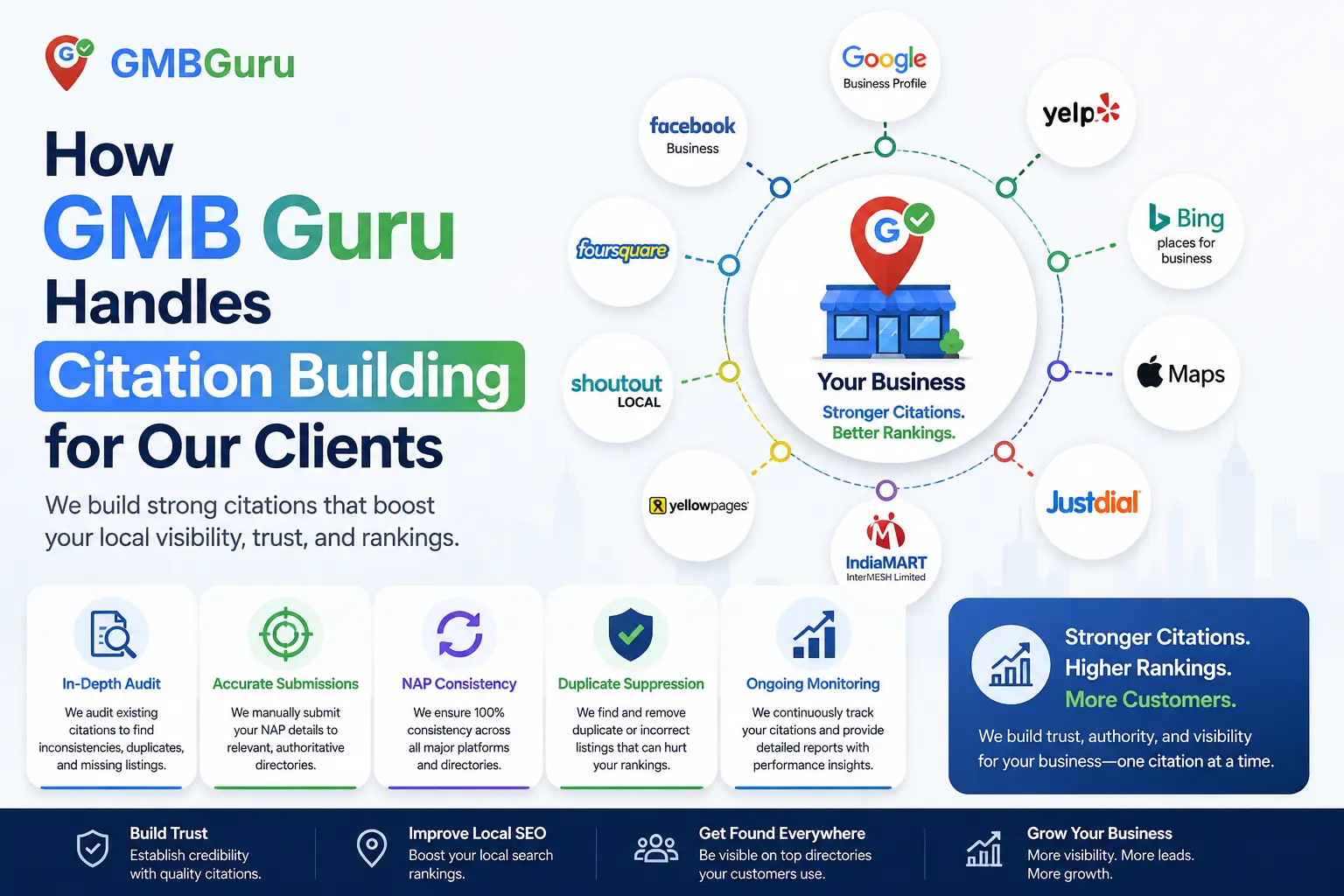
How GMB Guru Handles Citation Building for Our Clients
Step 1: Full Citation Audit
Before we build a single new listing, our team runs a comprehensive citation audit for every new client. We use professional-grade tools to scan the web and identify every existing mention of your business — structured and unstructured. We document every inconsistency, every duplicate listing, and every missing citation opportunity. This audit becomes the roadmap for everything that follows.
Step 2: Cleanup, Correction, and Duplicate Suppression
Duplicate listings are one of the most damaging citation problems a business can have. If Google finds multiple listings for your business at the same address — a common result of directory data aggregators creating listings automatically — it can suppress all of them or create genuine confusion about which listing to trust. Our team manually corrects inaccurate citations and works to suppress or merge duplicate listings across all major platforms. This alone often produces a noticeable improvement in Google Maps rankings within 60–90 days.
Step 3: Core Directory Submissions
Once your existing citation landscape is clean, we build out your presence across the most authoritative business directories. Our core citation list includes the major data aggregators that feed information to dozens of downstream directories automatically — platforms like Data Axle, Neustar Localeze, and Foursquare's data network. Getting your data right at the aggregator level creates a ripple effect of accurate citations across the web.
We also ensure you're listed on the top-tier directories that Google considers high-authority signals: Yelp, Bing Places, Apple Maps, BBB, Angi, Thumbtack (for applicable industries), and the major social platforms.
Step 4: Industry-Specific and Hyper-Local Directories
This is where many citation services stop — and where GMB Guru goes further. Beyond the universal directories, we identify and build citations on industry-specific platforms relevant to your business category (e.g., Healthgrades and Vitals for medical practices, Houzz for home services, Avvo for legal firms, TripAdvisor for hospitality) and hyper-local directories specific to your city or region (local chamber of commerce listings, city business directories, regional news sites with business profiles).
These niche citations carry disproportionate weight because they signal category relevance to Google — not just existence, but expertise and industry legitimacy. If you want to understand how this fits into the broader picture of ranking on Google Maps, check out our guide on Google Maps SEO and our deep-dive article on Google Maps ranking factors in 2026.
Quality vs. Quantity: Why 50 Strong Citations Beat 500 Weak Ones
There was a time in local SEO when the strategy was simple: get listed everywhere possible, as fast as possible. That era is over. Google's algorithms have become significantly more sophisticated at evaluating citation quality, and mass-blasting your NAP data to thousands of low-quality directories can actually trigger spam filters and hurt your rankings.
The metrics that actually matter in citation quality today are:
- Domain Authority of the Directory: A citation on Yelp (DA 93) is worth dramatically more than one on an obscure directory with DA 12.
- Relevance of the Directory: Being listed on a healthcare directory when you're a medical practice sends a stronger relevance signal than a generic business directory.
- Completeness of the Listing: A complete listing with business description, categories, photos, hours, and website URL carries more weight than a bare NAP-only entry.
- Activity and Engagement: Directories that allow and display reviews, Q&A, and photos provide more ranking signal than static listing pages.
Our team at GMB Guru maintains a curated list of vetted, high-authority directories organized by industry vertical and geographic market. We don't submit to junk directories — every citation we build is one that adds genuine ranking value.
How Citations Amplify Your Google Business Profile
Citations don't work in isolation — they work in concert with your Google Business Profile. Think of your GBP as the centerpiece of your local SEO presence and citations as the supporting structure that validates and amplifies everything your GBP claims about your business.
When Google sees that the NAP data on your GBP matches the NAP data on 80+ authoritative directories across the web, it treats your GBP listing as highly trustworthy. That trust translates into better rankings in the Map Pack, higher visibility in local search results, and ultimately more calls, website visits, and customers walking through your door.
This is why our Google Business Profile optimization service always includes a citation audit and cleanup component. It's not an optional add-on — it's a foundational requirement for profile performance. If you haven't fully optimized your GBP yet, our comprehensive guide on how to optimize your Google Business Profile in 2026 is an excellent starting point.
Citation Monitoring: The Ongoing Work Most Businesses Skip
Here's an uncomfortable truth: citation building is not a one-time task. The web is constantly changing. Directories update their data. Aggregators push new information. Competitors or users can suggest edits to your listings on platforms like Google and Yelp. Old, incorrect addresses and phone numbers can resurface from archived web sources months or years after you thought they were fixed.
Without ongoing monitoring, your citation profile can degrade over time — and you'll have no idea it's happening until you notice your rankings sliding. Our team provides ongoing citation monitoring for clients as part of our local SEO service packages, checking for unauthorized changes, new duplicate listings, and data consistency across your top-priority directories on a regular basis.
This kind of proactive maintenance is one of the reasons our clients see sustained ranking improvements rather than temporary spikes. For a broader look at how citation building fits into a complete local search strategy, our Local SEO GMB Playbook covers the full picture.
DIY Citation Building vs. Hiring a Professional — What's the Real Difference?
We get this question often, and we'll be honest with you: basic citation building on a handful of major directories is something any business owner can do themselves. Creating your Yelp listing, getting on Bing Places, and submitting to Google Business Profile — that's achievable with a few hours of focused work.
But the work that actually moves the needle on Google rankings — the comprehensive audit, the duplicate suppression, the data aggregator submissions, the niche directory research, the completeness optimization, the ongoing monitoring — that's where the complexity compounds quickly. Most business owners who attempt a full citation strategy on their own either run out of time partway through or introduce new inconsistencies in the process of trying to fix old ones.
Our clients typically see measurable ranking improvements within 60–120 days of beginning a professional citation campaign — improvements that persist and compound over time because the underlying data foundation is solid.
Your Local Citation Building Checklist
Whether you're starting from scratch or auditing an existing citation profile, use this checklist as your framework:
- ✅ Audit existing citations — Use a tool like BrightLocal or Whitespark to find all existing mentions of your business
- ✅ Standardize your NAP data — Decide on exact formats for your business name, address, and phone number and document them
- ✅ Correct all inaccurate listings — Update every directory where your data is wrong or outdated
- ✅ Suppress or merge duplicate listings — Contact directories directly or use their management tools to eliminate duplicates
- ✅ Submit to data aggregators — Ensure your correct data is in Data Axle, Neustar Localeze, and Foursquare
- ✅ Build listings on top-tier directories — Yelp, Bing Places, Apple Maps, BBB, Facebook, and others relevant to your industry
- ✅ Target niche and local directories — Identify industry-specific and city/region-specific directories for your business type
- ✅ Optimize each listing for completeness — Add photos, descriptions, hours, categories, and website URLs to every listing
- ✅ Monitor and maintain regularly — Set a schedule to check your top citations for unauthorized changes at least quarterly
- ✅ Align citations with your GBP — Ensure your Google Business Profile data exactly matches what appears in your citations
Ready to Build a Citation Profile That Actually Ranks?
Local citations are one of those areas of SEO where the gap between doing it adequately and doing it expertly is enormous — and that gap shows up directly in your Google Maps rankings and the number of customers who find you versus your competitors.
At GMB Guru, citation building is just one component of our comprehensive local SEO approach. We handle the full stack: profile optimization, citation auditing and building, review strategy, content optimization, and ongoing monitoring — all coordinated to move your business up in the Map Pack and keep it there.
If you're ready to stop guessing and start ranking, our team is here to help. Explore our local SEO services or our dedicated Google Maps SEO service to see exactly how we approach this work — and what results our clients are getting. A stronger local presence starts with a solid citation foundation, and we build those every day.