- Why Local Links Matter for Google Maps Rankings
- Citations vs. Backlinks: Understanding the Difference
- What Are Local Citations?
- What Are Local SEO Backlinks?
- Which One Do You Need?
- 7 Types of Local Links That Actually Move Google Maps Rankings
- How GMB Guru Approaches Local Link Building for Our Clients
- Step 1: Competitor Backlink Gap Analysis
- Step 2: Hyper-Local Outreach Campaigns
- Step 3: Linkable Asset Creation
- Anchor Text Strategy for Local Links
- 5 Common Local Link Building Mistakes That Hurt Rankings
- How to Measure Local Link Building Success
- How Local Links Interact with Your Google Business Profile
- Getting Started with Local Link Building: Your Action Plan
- Want This Done for You? Here's How GMB Guru Can Help
The Ultimate Guide to Local Link Building for Google Maps Rankings
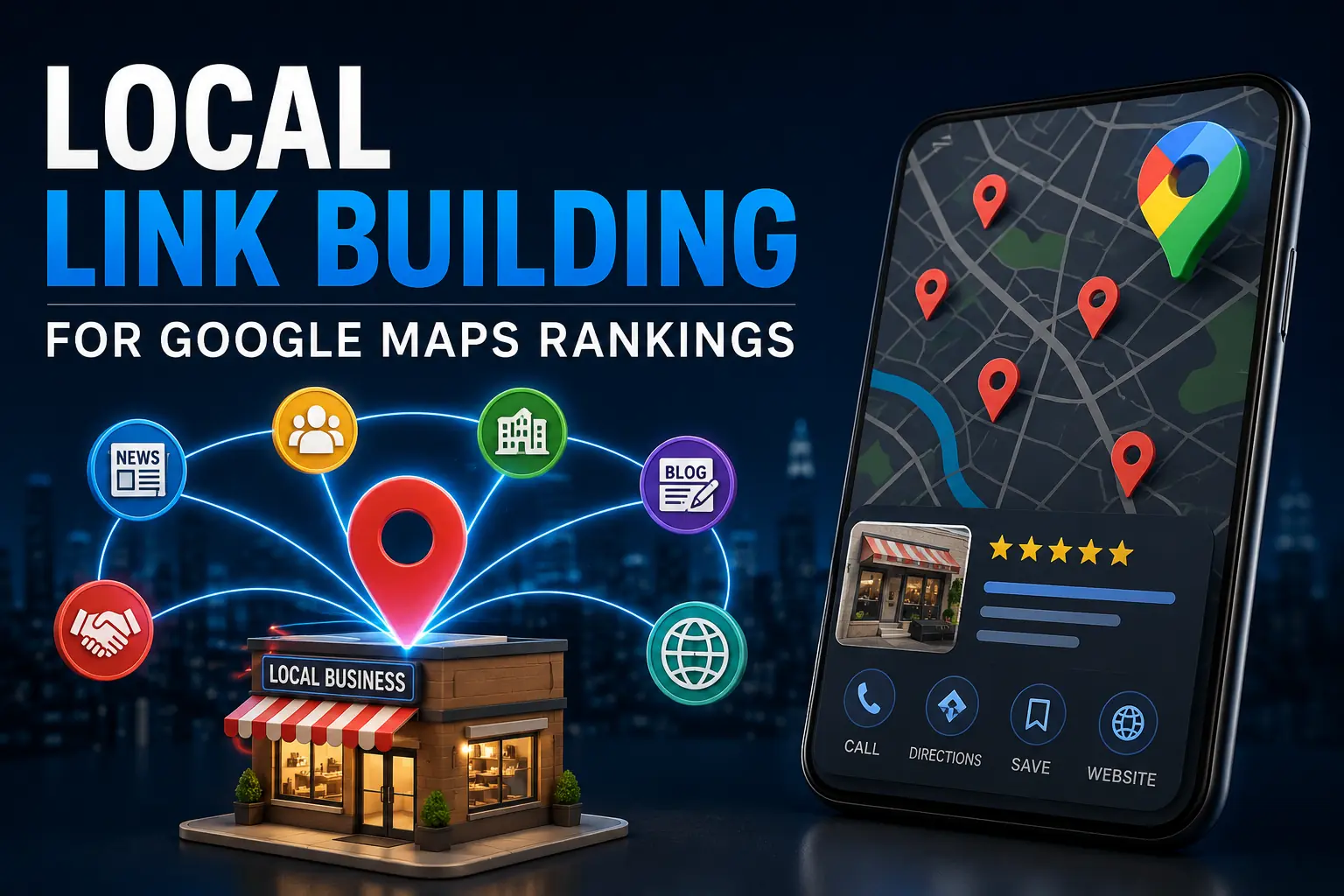 If your business is showing up on page two of Google Maps — or not showing up at all — there's a good chance your local link building strategy is either underdeveloped or completely missing. Most business owners focus heavily on their Google Business Profile and on-page SEO, which absolutely matter, but they overlook one of the most powerful off-page signals Google uses to rank local businesses: the authority and relevance of the websites linking back to them. The good news? Local link building isn't as complicated as national SEO link building, and when done correctly, it can be the tipping point that pushes your listing into the coveted Google Maps 3-Pack. In this guide, we'll break down exactly what local link building is, how it differs from citations, and the proven strategies our team at GMB Guru uses to help US businesses earn more visibility on Google Search and Google Maps.
Why Local Links Matter for Google Maps Rankings
Google's local ranking algorithm is built on three core pillars: relevance, distance, and prominence. While relevance and distance are largely controlled through your Google Business Profile and your physical location, prominence is where link building plays a starring role. Prominence refers to how well-known and authoritative Google perceives your business to be — and backlinks from other websites are one of the clearest signals of that authority.
According to Google's own documentation on how local results are ranked, prominence is influenced by information Google has about a business across the web, including links and articles. In practical terms, that means a plumber in Austin with 40 high-quality local backlinks will almost always outrank a competitor with zero backlinks — even if both profiles are otherwise identical.
Our clients at GMB Guru regularly see ranking improvements of 15–40 positions on Google Maps after a structured local link building campaign is implemented alongside a fully optimized Google Business Profile. Links don't operate in isolation — they amplify everything else you're doing for local SEO.
Citations vs. Backlinks: Understanding the Difference
One of the most common points of confusion we see — even among business owners who have worked with other SEO agencies — is the difference between citations and backlinks. These two things are often lumped together, but they serve very different purposes in local SEO.
What Are Local Citations?
A local citation is any online mention of your business's Name, Address, and Phone Number (NAP). Citations appear on directories like Yelp, Yellow Pages, Angi, BBB, and hundreds of industry-specific platforms. They do not need to include a clickable link back to your website to count. Their primary job is to validate that your business exists, is consistent, and is legitimate. Google uses citation consistency as a trust signal — if your NAP information is inconsistent across 50 directories, it creates doubt about which information is accurate.
What Are Local SEO Backlinks?
A backlink is a clickable hyperlink from another website that points to your website. Backlinks pass what SEO professionals call "link equity" or "link juice" — essentially, they transfer a portion of one site's authority to yours. For local SEO, the most valuable backlinks come from locally relevant sources: your city's Chamber of Commerce, local news outlets, community blogs, local event sponsors, and regional industry associations. A single backlink from a well-established local news site can be worth more than 50 directory listings in terms of ranking impact.
Which One Do You Need?
You need both — but in the right order. Citations come first because they establish foundational trust and NAP consistency. Backlinks come next and drive meaningful ranking authority. Think of citations as your business's local credibility baseline and backlinks as the accelerator. Most businesses that plateau in local rankings have decent citations but weak backlink profiles. That's where the real opportunity lies, and that's exactly where our local SEO services at GMB Guru focus once the citation foundation is solid. You can also read more about building that foundation in our guide on local citations that actually improve Google rankings.
7 Types of Local Links That Actually Move Google Maps Rankings
Not all links are created equal. Here are the seven types of local backlinks that consistently produce results for our clients:
- Chamber of Commerce Links: Most local chambers offer a business directory listing with a dofollow link. These are highly trusted by Google because chambers are established community organizations. Membership fees are often worth it for the link alone.
- Local News and Media Coverage: A feature story or even a brief mention in a local newspaper or news website carries enormous link authority. Pitch story angles tied to community events, local business milestones, or expert commentary.
- Sponsorship Links: Sponsoring local events, youth sports teams, charity fundraisers, or school programs often comes with a backlink from the organization's website. These links are highly relevant and genuinely earned.
- Local Business Associations: Industry-specific local associations — think local homebuilders associations, restaurant groups, or contractors guilds — often maintain member directories with links.
- Local Blogger and Influencer Features: Local lifestyle bloggers, city guides, and community influencers frequently write "best of" roundups. Getting your business included in a "Best Plumbers in Denver" post earns you a contextual backlink with natural anchor text.
- University and .edu Links: If your business offers student discounts, partners with university programs, or participates in internship programs, you may qualify for a listing on a university website — one of the most authoritative link sources available.
- Supplier and Partner Links: Your vendors, suppliers, and business partners often have "trusted partners" or "where to buy" pages. Reach out and ask to be listed — these links are often free and highly relevant.
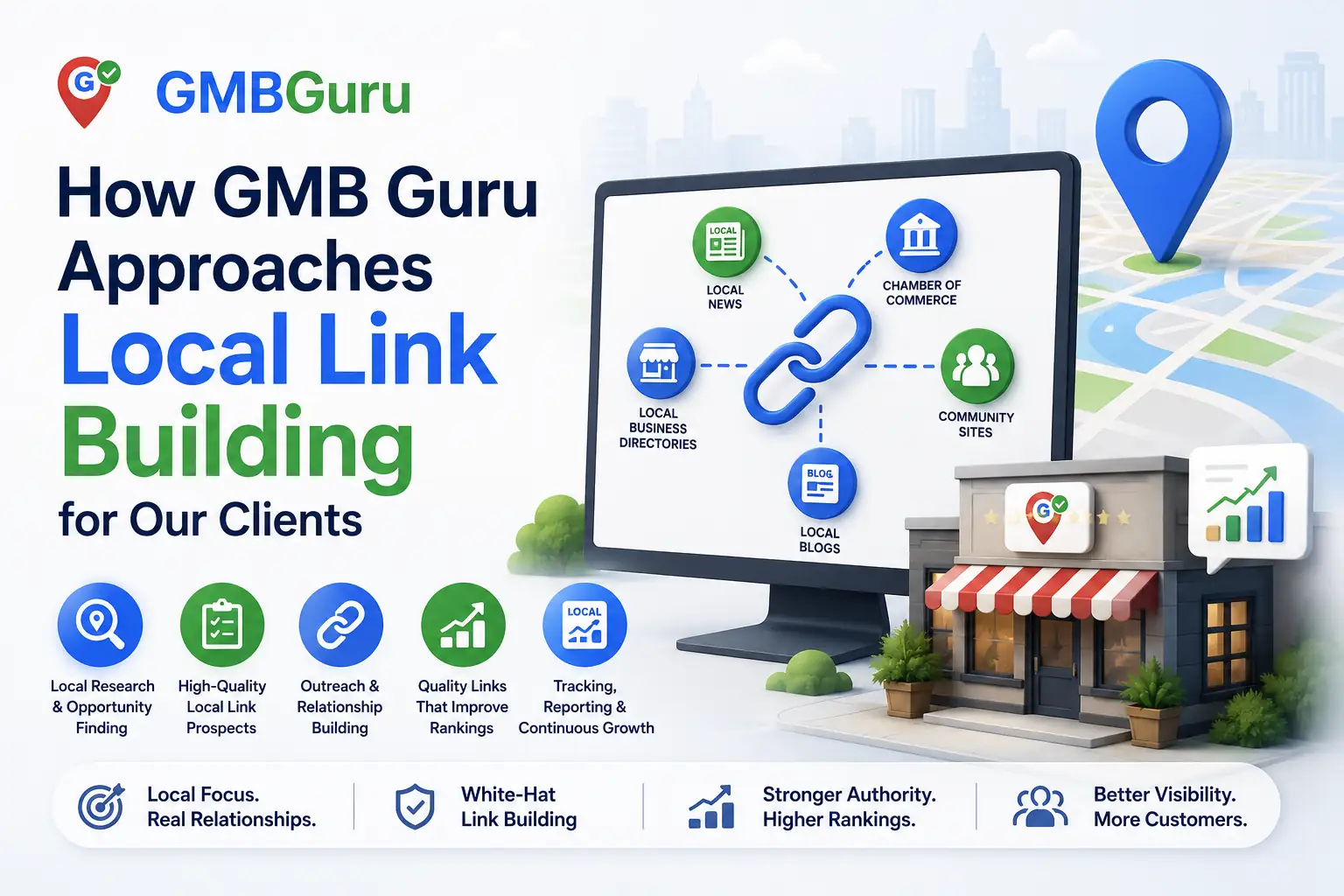
How GMB Guru Approaches Local Link Building for Our Clients
 Step 1: Competitor Backlink Gap Analysis
Before we build a single link, our team conducts a thorough backlink gap analysis for every new client. We identify the top three to five local competitors currently ranking in the Google Maps 3-Pack for your target keywords, audit their complete backlink profiles, and map out every link source they have that you don't. This gives us a prioritized hit list of the most impactful link opportunities specific to your market and industry — not a generic checklist that works the same way for every business.
Step 2: Hyper-Local Outreach Campaigns
Our outreach team specializes in building relationships with locally relevant websites — not mass-blasting hundreds of low-quality directories. We identify the right contacts, craft personalized pitches, and follow up systematically. Our average client in a mid-sized US market earns between 8 and 20 new local backlinks in the first 90 days of an active campaign. For clients in competitive metro areas like Los Angeles, Chicago, or Miami, that number often reaches 25–35 new links in the same timeframe.
Step 3: Linkable Asset Creation
The best way to earn backlinks at scale is to create content that local websites want to link to. Our team creates locally relevant resources — neighborhood guides, local industry statistics, how-to content, and community resource pages — that naturally attract inbound links without requiring constant outreach. This approach compounds over time, generating ongoing passive link acquisition that keeps building authority long after the initial campaign.
For a deeper dive into how all of this fits into a complete local strategy, check out our Local SEO GMB Playbook and our breakdown of Google Maps ranking factors in 2026.
Anchor Text Strategy for Local Links
Anchor text — the clickable words in a hyperlink — plays a meaningful role in how Google interprets the relevance of a backlink. For local SEO, the ideal anchor text distribution looks something like this:
- Branded anchors (40–50%): Your business name, e.g., "Smith's Plumbing" or "GMB Guru"
- Local keyword anchors (20–30%): Service plus city, e.g., "plumber in Austin" or "Denver roofing company"
- Naked URLs (10–15%): Your raw website URL, e.g., "yourwebsite.com"
- Generic anchors (10–15%): "Click here," "learn more," "visit their website"
- Exact match keyword anchors (5–10%): Pure keyword phrases — use sparingly to avoid over-optimization penalties
Over-optimizing with too many exact match keyword anchors is a common mistake that can actually trigger a Google penalty. Our team monitors anchor text distribution carefully as part of our ongoing local SEO management process to keep profiles clean and penalty-free.
5 Common Local Link Building Mistakes That Hurt Rankings
In our years of working with US local businesses, we've seen the same link building mistakes surface repeatedly. Here's what to avoid:
- Buying links from link farms or PBNs: Paid link schemes may produce short-term gains but almost always result in manual penalties or algorithmic devaluations that are painful and costly to recover from.
- Ignoring link relevance: A backlink from a local pet store doesn't help a law firm. Relevance — both topical and geographic — is critical for local link authority.
- Focusing only on DA/DR scores: Domain Authority is a third-party metric, not a Google metric. A lower-DA local community blog can outperform a high-DA national site in local ranking impact because of geographic relevance.
- Neglecting internal linking: Strong external backlinks are most effective when they point to well-structured website pages that link internally to your service pages and location pages.
- Building links without fixing your GBP first: Links amplify your existing Google Business Profile signals. If your profile is incomplete, uncategorized, or missing key information, link building produces diminished returns. Make sure your profile is fully optimized — review our GMB optimization checklist for 2026 as a starting point.
How to Measure Local Link Building Success
Link building is a long game, but there are clear signals you can track to gauge progress. Our team monitors the following KPIs for every active local SEO client:
- Google Maps 3-Pack appearances for target keywords (tracked weekly using rank tracking tools)
- Number of referring domains (new linking root domains added per month)
- Organic website traffic from local searches (tracked via Google Search Console)
- Google Business Profile impressions and direction requests (available directly inside GBP Insights)
- Phone call conversions from Google Maps (tracked via call tracking integration)
Most of our clients begin to see measurable ranking improvements within 60–90 days of starting a structured link building campaign. Full competitive dominance in mid-to-large markets typically requires a 6-month sustained effort, which is why we structure our local SEO engagements as ongoing retainer partnerships rather than one-time projects.
How Local Links Interact with Your Google Business Profile
Here's something many business owners and even some SEO practitioners miss: your Google Business Profile and your website's backlink profile are not separate ranking systems. They feed each other. Google connects the signals from your GBP — reviews, categories, posts, Q&A responses, photos — with the off-page signals from your website, including its backlinks. When both are strong, the ranking impact is multiplicative, not just additive.
This is why our approach at GMB Guru never treats link building as an isolated tactic. Every link building campaign we run is built on the foundation of a fully optimized Google Business Profile. Without that foundation, even excellent backlinks will underperform. With it, a modest but well-targeted link building effort can produce remarkable ranking results in surprisingly competitive markets.
Getting Started with Local Link Building: Your Action Plan
If you're ready to start building local links, here's a practical checklist to work from:
- ✅ Audit your current backlink profile using a tool like Ahrefs, Semrush, or Moz — understand where you stand before you build
- ✅ Analyze your top 3 local competitors' backlink profiles and identify gap opportunities
- ✅ Join your local Chamber of Commerce and claim your directory listing with a link
- ✅ Identify 5 local sponsorship opportunities in your area — events, nonprofits, sports teams
- ✅ Reach out to 10 local business partners and request mutual linking on partner pages
- ✅ Create one high-value local resource page that local blogs, news sites, or organizations would want to reference
- ✅ Ensure your Google Business Profile is fully optimized before amplifying with links
- ✅ Track progress monthly using Google Search Console, GBP Insights, and rank tracking tools
Want This Done for You? Here's How GMB Guru Can Help
Local link building is one of those strategies that most business owners understand conceptually but rarely execute consistently — because it takes time, expertise, and persistent outreach. Between running your business and serving your customers, it's genuinely hard to also be conducting competitor backlink audits, crafting outreach emails, and building linkable content assets every month.
That's exactly what our team at GMB Guru does for our clients. We're a certified Google Business Profile agency specializing in local SEO for US businesses, and local link building is a core component of every comprehensive local SEO engagement we run. We handle the analysis, the outreach, the content creation, and the ongoing monitoring — so you can focus on what you do best while we push your rankings higher on Google Maps and Google Search.
Whether you're starting from scratch with a brand new local presence or you've been plateauing in local rankings for months despite having a strong GBP, our team knows exactly what levers to pull. Explore our local SEO services to see how we approach link building as part of a full local SEO strategy, or reach out directly to talk through what's holding your rankings back. The businesses ranking above you right now aren't just better — they're better optimized. Let's change that.