- What Is NAP Consistency and Why Does Google Care?
- NAP Signals as a Local Ranking Factor
- The Most Common NAP Inconsistencies (And Where They Hide)
- Understanding Local Citations and Their Role in Business Listings
- What Is a Local Citation?
- The Citation Sources That Matter Most
- How GMB Guru Audits and Fixes NAP Consistency for Clients
- Step 1 — Establish a Master NAP Record
- Step 2 — Full Citation Scan Across 100+ Directories
- Step 3 — Corrections, Submissions, and Suppression
- Step 4 — Ongoing Monitoring and Maintenance
- NAP on Your Own Website: The Foundation Beneath the Foundation
- NAP Consistency for Multi-Location Businesses
- How Long Does It Take to See Results from NAP Cleanup?
- Quick NAP Consistency Checklist for Local Businesses
- Ready to Get Your Citations in Order? Here's Who to Talk To
NAP Consistency: Why Your Business Name, Address, and Phone Number Matter for Local SEO
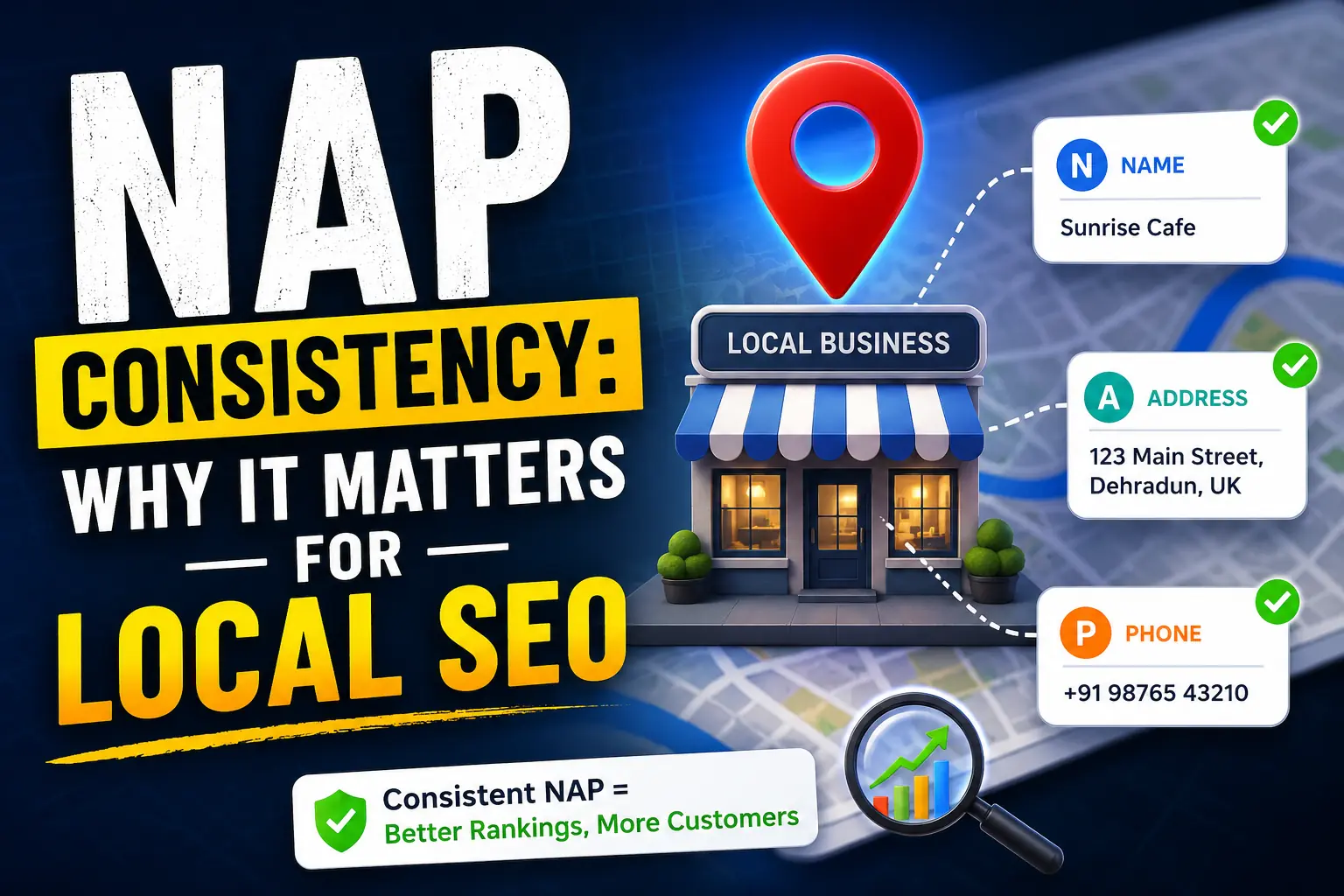 If your business shows up differently across Google, Yelp, Facebook, and dozens of other online directories — even with something as minor as "St." versus "Street" — you could be quietly bleeding local search rankings without ever knowing why. NAP consistency (your business Name, Address, and Phone number) is one of the most foundational yet most overlooked signals in local SEO. Get it wrong, and Google loses trust in your business data. Get it right, and you create a compounding advantage that pushes you higher in Google Search and Google Maps results. At GMB Guru, we audit and correct NAP consistency as a core part of our local SEO work — and the results our clients see speak for themselves. Let's break down exactly what NAP consistency is, why it matters so much, and what a professional fix actually looks like.
What Is NAP Consistency and Why Does Google Care?
NAP stands for Name, Address, and Phone Number — the three most fundamental pieces of identifying information for any local business. NAP consistency means that these three data points appear in exactly the same format, spelling, and structure across every platform where your business is listed online.
Google's local search algorithm works by crawling hundreds of data sources — directories, social profiles, review platforms, data aggregators, and your own website — to build a confident picture of who your business is and where it's located. When Google finds matching NAP data across multiple authoritative sources, it interprets that as a strong trust signal. Conflicting data, on the other hand, creates ambiguity. And Google doesn't reward ambiguity — it rewards certainty.
According to Google's own guidelines for representing your business, your business name should be exactly as it appears in the real world, and your address should precisely reflect your physical location. Deviating from this — even unintentionally — can suppress your local rankings.
NAP Signals as a Local Ranking Factor
Local SEO research consistently identifies citation signals — including NAP consistency — as a meaningful ranking factor in Google Maps and the Local Pack results. In fact, BrightLocal's annual Local Search Ranking Factors survey has repeatedly shown that citation consistency contributes to where your business appears in the coveted 3-pack of local results.
Here's why this matters in practice: when 15 different directories list your business as "Mike's Plumbing LLC" but your Google Business Profile says "Mike's Plumbing," and your website footer says "Mike's Plumbing Services," Google is now looking at three different entities. Each inconsistency dilutes your authority. Each match, on the other hand, reinforces it. With enough consistent citations pointing to the same NAP, Google becomes more confident — and more confident businesses rank higher.
If you're already working on your Google Business Profile optimization but haven't addressed your citations, you're leaving serious ranking potential on the table. Our team at GMB Guru treats NAP consistency as Step One — because no amount of review generation or post scheduling will fully compensate for a fractured citation footprint. Learn more about our full approach in our local SEO services.
The Most Common NAP Inconsistencies (And Where They Hide)
Most business owners don't realize how many places their NAP data lives online — or how many discrepancies have accumulated over time. Here are the most common inconsistencies we uncover in client audits:
- Name variations: "Joe's HVAC" vs. "Joe's HVAC Inc." vs. "Joes HVAC" (missing apostrophe)
- Address abbreviations: "123 Main Street" vs. "123 Main St" vs. "123 Main St." — all technically the same, but flagged as different by data crawlers
- Suite/unit formatting: "Suite 200" vs. "Ste. 200" vs. "#200"
- Phone number formats: "(555) 867-5309" vs. "555-867-5309" vs. "5558675309"
- Old addresses from previous locations still live on directories that were never updated
- Tracking phone numbers used for ads that accidentally made it onto directories instead of your primary number
- Duplicate listings on the same platform with conflicting data
Any one of these might seem trivial. Multiplied across 50–100 directories, they add up to a significant trust problem. Our team at GMB Guru regularly finds clients with 30–40% of their citations containing at least one data discrepancy — and many of those discrepancies are years old. For more on how duplicate listings specifically cause problems, see our guide on Google Maps SEO and how we resolve them.
Understanding Local Citations and Their Role in Business Listings
 What Is a Local Citation?
A local citation is any online mention of your business's NAP data. Citations can be structured (a formal directory listing with dedicated fields for name, address, and phone) or unstructured (a blog post, news article, or community page that mentions your business). Both types matter for local SEO, but structured citations on high-authority directories carry the most weight.
The Citation Sources That Matter Most
Not all business listings are created equal. Google places more trust in citations from authoritative, well-indexed platforms. The top-tier sources include:
- Google Business Profile — the most important listing of all
- Yelp — high domain authority and heavily crawled
- Apple Maps — feeds into Siri and Maps on iOS devices
- Bing Places — still relevant for a meaningful slice of search traffic
- Facebook Business Page — major social signal with high crawl frequency
- Data aggregators — Neustar Localeze, Data Axle, and Foursquare distribute your NAP data to hundreds of downstream directories automatically
- Industry-specific directories — Houzz for contractors, Healthgrades for medical practices, Avvo for attorneys, etc.
- Better Business Bureau (BBB)
- Chamber of Commerce listings
The data aggregators deserve special attention. If your NAP data is incorrect at the aggregator level, that bad data gets distributed downstream to hundreds of smaller directories — and fixing individual listings one by one won't solve the root problem. You have to fix it at the source. This is something many DIY citation efforts miss entirely, and it's a key part of what we address in our Google Business Profile optimization service.
How GMB Guru Audits and Fixes NAP Consistency for Clients
When a new client comes to us with stagnant local rankings or inconsistent visibility across Google Maps, one of the first things our team does is a full NAP and citation audit. Here's exactly what that process looks like:
Step 1 — Establish a Master NAP Record
Before we fix anything, we work with the client to define a single, authoritative version of their NAP — exactly how their business name should appear, the precise USPS-verified address format, and the primary phone number that will be used across all platforms. This becomes the source of truth for every citation correction we make.
Step 2 — Full Citation Scan Across 100+ Directories
We use professional-grade tools to scan 100+ major directories and data sources for any existing mention of the client's business. We document every listing, flag every discrepancy, and identify duplicate listings that need to be either merged or removed. This audit typically surfaces 20–60 citation issues for businesses that have never had a professional citation audit done.
Step 3 — Corrections, Submissions, and Suppression
Our team then systematically corrects every inaccurate listing, claims unclaimed profiles, creates new listings on high-authority directories where the business has no presence, and suppresses or removes duplicate entries. We also correct the data aggregators first, which initiates a downstream correction across dozens of secondary directories that pull from those sources.
Step 4 — Ongoing Monitoring and Maintenance
NAP management isn't a one-time fix. Directories scrape and overwrite data. Competitors can suggest edits to your Google Business Profile. Data aggregators update periodically. We monitor our clients' citation health on an ongoing basis and address any new discrepancies before they compound into ranking problems. This ongoing vigilance is part of what separates a professional local SEO engagement from a DIY approach.
Want to see what a fully optimized local presence looks like? Our blog post on local citations that actually improve Google rankings goes deeper on which directories move the needle and why.
NAP on Your Own Website: The Foundation Beneath the Foundation
One detail many businesses miss: your website itself is a citation source. Google crawls your website and compares the NAP data it finds there against what it sees everywhere else online. If your website footer, contact page, and structured data (Schema markup) don't match your Google Business Profile and your top directory listings, you're creating a conflict at the most fundamental level.
Best practices for on-site NAP include:
- Display your NAP in crawlable HTML text on every page — not just in an image or embedded map
- Implement LocalBusiness Schema markup that matches your master NAP record exactly
- Make sure your contact page, about page, and footer all display identical NAP data
- If you have multiple locations, create individual location pages with unique, location-specific NAP data for each
Our Google Maps SEO service includes a full on-site NAP and Schema audit, so we're not just fixing your external citations — we're ensuring your website is reinforcing the same trust signals from the ground up.
NAP Consistency for Multi-Location Businesses
If you operate more than one location, NAP consistency becomes significantly more complex. Each location needs its own unique NAP profile — its own GBP listing, its own directory entries, and its own set of consistent citations. The challenges multiply accordingly:
- Data aggregators may merge location data or assign the wrong address to the wrong location
- Duplicate listings across locations are common and can cannibalize each other's rankings
- Employees or franchisees may create rogue listings with inconsistent information
- Old locations that have closed may still have active listings pulling traffic away from current ones
GMB Guru has worked with multi-location clients across healthcare, retail, legal, and home services. We build location-by-location citation profiles that are consistent within each location and cleanly differentiated from one another — so each location gets full credit for its own local signals.
How Long Does It Take to See Results from NAP Cleanup?
This is one of the most common questions we get, and we'll be honest: NAP corrections don't produce overnight ranking jumps. Here's a realistic timeline based on our client experience:
- Weeks 1–4: Corrections submitted to major directories and data aggregators. Google begins recrawling updated listings.
- Weeks 4–8: Most tier-1 directories reflect corrected data. Google's trust in your NAP data begins to stabilize.
- Months 2–4: Downstream directories updated via aggregators. Local ranking improvements typically begin to appear in this window, especially in competitive markets.
- Months 4–6: Full citation footprint stabilized. Ranking gains compound as consistent citation signals accumulate alongside other local SEO work.
NAP cleanup is most powerful when combined with a comprehensive local SEO strategy — optimized Google Business Profile, consistent review generation, relevant GBP posts, and proper category selection. Read our guide on how to optimize your Google Business Profile in 2026 to see how these elements work together.
Quick NAP Consistency Checklist for Local Businesses
Before you hire anyone or touch a single directory, run through this checklist to understand where you stand:
- ☑ Define your master NAP — agree on the exact business name, USPS-verified address, and primary phone number you will use everywhere
- ☑ Audit your Google Business Profile — confirm your GBP matches your master NAP exactly
- ☑ Check your website — footer, contact page, and Schema markup should all be identical to your master NAP
- ☑ Search your business name on Google — look at the top directory results and spot any visible discrepancies
- ☑ Check the big 4 aggregators — Neustar Localeze, Data Axle, Foursquare, and Factual (now Foursquare) for accuracy
- ☑ Scan Yelp, Bing Places, Apple Maps, and Facebook — manually verify NAP data on each
- ☑ Identify and suppress duplicates — any duplicate listing is a liability, not just a redundancy
- ☑ Set a recurring reminder to recheck top listings every 90 days for data drift
If working through that list feels like a project you don't have time for — or you've already tried fixing it yourself and the inconsistencies keep coming back — that's exactly the scenario GMB Guru was built for.
Ready to Get Your Citations in Order? Here's Who to Talk To
NAP consistency is one of those local SEO fundamentals that sounds simple but hides significant complexity beneath the surface. The businesses that get it right — and keep it right — tend to outrank competitors who are doing everything else correctly but ignoring their citation health. It's not glamorous work, but it's foundational work, and it pays dividends for years.
At GMB Guru, we've helped hundreds of US businesses clean up their citation footprints, stabilize their NAP data, and build the kind of local authority that Google rewards with better rankings and more customers. Our process is systematic, thorough, and backed by real results. We don't guess — we audit, fix, monitor, and report.
Whether you're a single-location small business that's never touched your citations, or a multi-location brand dealing with years of data drift, our team has the tools and experience to handle it. Explore our local SEO services to see the full scope of what we do, or dive into our Google Business Profile optimization service if you want to start with your most important listing first. And if you've got questions or want a free assessment of your current citation health, we're here to help — no hard pitch, just honest advice from a team that does this every day.